An organic fertilizer granulation line can turn composted raw materials into commercial organic fertilizer products. The main equipment of this line includes feeding, crushing, screening, batching, granulation, drying, cooling, packing, and palletizing equipment. Whether you want to choose a dry organic fertilizer granulation process or a wet organic fertilizer granulation process, your target capacity is 1–3 t/h, 3–10 t/h, or 10–20 t/h, or your budget is USD 110–140k, USD 140–360k, or USD 360–550k, we can customize the most suitable organic fertilizer granulation line according to your actual raw materials, capacity, budget, and project requirements.

organic fertilizer pelleting system

Is your organic fertilizer granulation line suitable for my raw material?

Whether your material moisture is 20%–40% or below 20%, we can provide a suitable organic fertilizer manufacturing project for your project.

Wet Organic Fertilizer Pelleting System

If your material moisture is 20%–40%, such as chicken manure, cow dung, sewage sludge, or organic waste mixture, we recommend a wet granulation process. These materials already contain suitable moisture, so they can form round organic fertilizer granules more easily during wet granulation. This process also works better when you want stable, commercial, and large-capacity organic fertilizer production.

Dry Organic Fertilizer Granule Production Line

For materials with a moisture content below 20%, such as dried compost powder, straw powder, peat, or organic-mineral powder blends, the dry granulation process is a suitable choice. This process can lower equipment costs because it usually eliminates the need for drying and cooling equipment. As a result, you can save energy, reduce workshop space requirements, and control your total investment more easily.

raw materials for organic fertilizer granulation

How does the organic fertilizer granulation line work?

To make the organic fertilizer production process more efficient, we recommend that you first understand how a complete organic fertilizer project works before choosing a suitable solution.

Precomposting for Granular Organic Fertilizer Making

  • First, you need to compost the raw material before granulation. Through composting, you can reduce harmful organisms and pathogen risks in the material, making it safer and more stable for the organic fertilizer granulation process.

  • After composting, the fermented material passes through a crusher to break large lumps into a more uniform powder. A screening machine then removes stones, undecomposed residues, and oversized materials that may affect mixing and granule formation.

  • Next, according to the required organic fertilizer formula, you can add nutrients, minerals, microbial carriers, or other functional materials through a batching system. A mixer then distributes these ingredients evenly throughout the composted material.

Organic Fertilizer Granulating Process

After the above preparation, your material enters the main organic fertilizer granulation stage.

  • First, the prepared material enters the organic fertilizer granulator. Inside the machine, mechanical force, moisture, and material adhesion work together to form the powder into organic fertilizer granules. As newly formed organic fertilizer granules usually contain excess moisture, so they then enter a rotary dryer to reduce the moisture content and improve fertilizer granule strength.

  • Next, after cooling, the granules enter a screening machine. Qualified particles move to the finishing stage, while fine powder and oversized granules return to the organic fertilizer production system for reprocessing. A coating or polishing process can be added when the finished organic fertilizer requires a smoother appearance, less dust, better anti-caking performance, or improved storage stability.

  • Finally, the finished organic fertilizer granules are weighed, packed, and stacked for delivery.

1–20 t/h Organic Fertilizer Granulation Solutions

Still struggling to decide which organic fertilizer granule making line to choose? You can start with one key question: how many tons of finished granules do you want to produce per hour?

If you run a small fertilizer plant or farm, you can choose a 1–3 t/h organic fertilizer roller extrusion pelletizing plant. With a compact dry extrusion line, you can save more when your material moisture is lower than 20%, because you usually do not need drying and cooling equipment. This helps you reduce fuel use, workshop space, and total project cost.

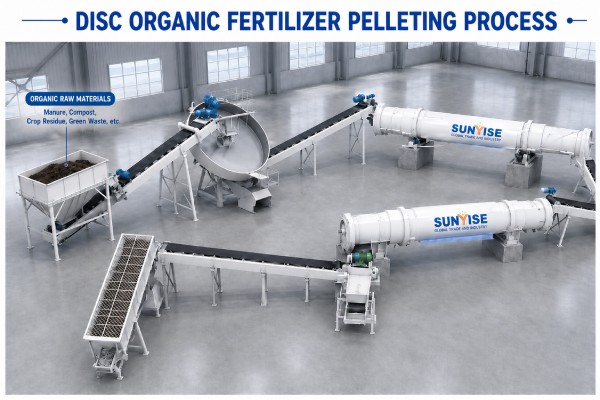
If your material moisture is higher than 20%, we recommend you to choose the organic fertilizer disc granulation system. This line has a lower investment cost, a simple structure, and easy operation. It can also reach a granulation rate of up to 93%, helping you produce organic fertilizer pellets more efficiently for small scale operation.

For a medium-capacity organic fertilizer pellet production project, such as 3–10 t/h, you can choose a new-type organic fertilizer granulator line. With this line, you can achieve a granulation rate of up to 95% and produce 2–5 mm organic fertilizer granules according to your needs.

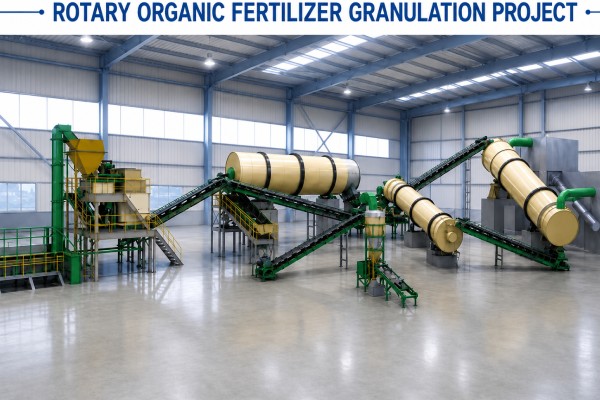
If your target capacity is 10–30 t/h, you can consider a rotary drum granulation line.

It supports large-capacity, continuous production, making it well suited for industrial organic fertilizer granule manufacturing. We can customize the system according to your production requirements, including options such as rubber lining, cleaning ports, and automatic control. These designs help your plant handle larger material flow, reduce downtime, and keep stable production for commercial organic fertilizer granules.

USD 110 to USD 550k:Cost of an Organic Fertilizer Manufacturing Line

Whether your budget is USD 110k or USD 550k, we can customize the most suitable organic fertilizer granulation line according to your needs.
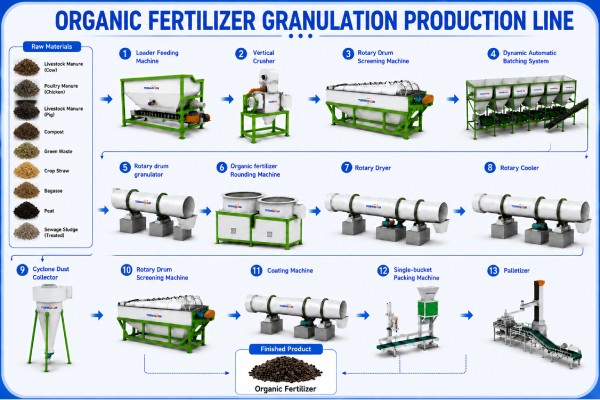
If your budget is USD 110–140k, you can choose a roller extrusion organic fertilizer pelletizing process. This 1–3 t/h organic fertilizer manufacturing line often includes wheel loader feeder → SXSF-60*Semi-wet Material crusher →SXGS-1030*rotary drum screener → dynamic automatic batching system →SXDJ-2T*double roller granulator → SXGS-1030*rotary drum screener → coating machine → single-bucket packing machine → palletizer.

For a medium organic fertilizer manufacturing process of about 3–10 t/h, the investment becomes higher because you need more stable feeding, finer crushing and screening, automatic batching, a suitable organic fertilizer granulator, drying, cooling, dust collection, and packing. A standard line includes wheel loader feeder → SXFLF-800*vertical crusher → SXGS-1560*rotary drum screener → dynamic automatic batching system → SXJZ-1500*new-type organic fertilizer granulator→ SXPY-1500*organic fertilizer polishing machine → SXHG-1818*rotary dryer → rotary cooler → SXGS-1560*rotary drum screener → coating machine → double-bucket packing machine → palletizer.

With a budget of around USD 360–550k, you can choose a 10–20 t/h organic fertilizer rotary drum processing system. This line usually includes wheel loader feeder →SXFLF-1000*vertical crusher →SXGS-2080*rotary drum screener → dynamic automatic batching system → SXZGZ-3210*rotary drum granulator → SXHG-2424*rotary dryer → rotary cooler → SXGS-2080*rotary drum screener → coating machine → double-bucket packing machine*2 → palletizer.

Venha obter sua solução de granulação de fertilizante agora!

Composting before organic fertilizer pelleting

When you use fresh organic waste as materials to make organic fertilizer, we suggest composting before granulation. This helps reduce harmful substances and prepare your material for stable organic fertilizer production. Then, according to your target output, we can help you choose the right compost turner.
  • If your target capacity is 1–3 t/h, you can choose a crawler compost turner. As it is flexible, easy to move, and requires less site construction. Its turning depth can reach 3 m, and the turning height is about 1.3–1.5 m.

  • On the condition that your target capacity is 3–10 t/h, its best to buy a groove type compost turner. This is because it works inside fermentation grooves and supports more stable, continuous material turning. What’s more, it supports a 5 m turning depth and an 0.8 m turning height.

  • When your planned capacity is around 10–20 t/h, we recommend a double wheel compost turner. Because it can process wider and deeper compost piles, helping your plant improve turning efficiency and fermentation capacity, with a turning depth of 1.5-3 m and a maximum turning height of 30 m.

Venha obter sua solução de granulação de fertilizante agora!

If you’re interested in the above fertilizer manufacturing projects, please send us your raw material type, target capacity, and budget. We can customize the most suitable fertilizer granulation solution for your project.