

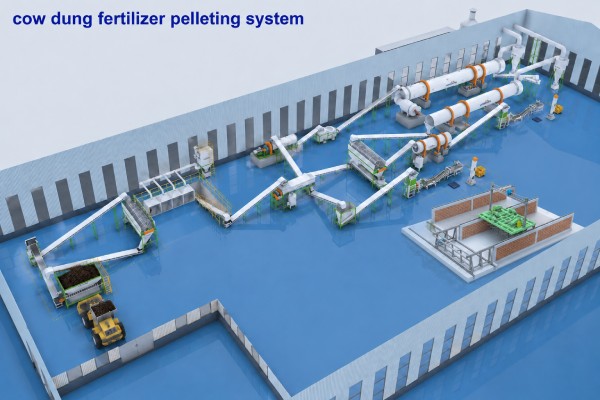
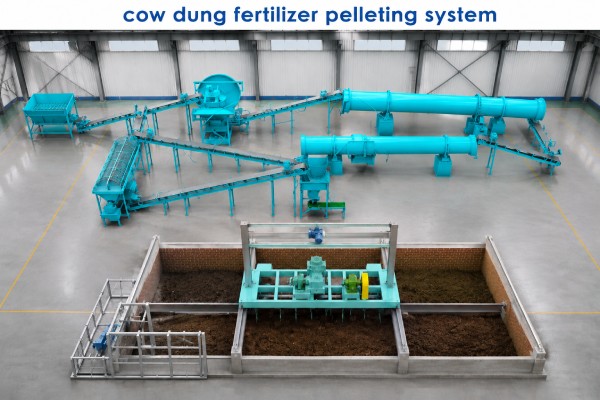
Cow dung fertilizer manufacturing requires pre-composting before granulation. For stable output and high granule strength, a rotary drum granulator is the optimal choice. As for a complete fertilizer production line, it typically includes inclined screw type solid liquid separator→ loader feeder→double-shaft horizontal mixer→groove type compost turner→ loader feeder→ vertical crusher→ rotary screening machine→ dynamic automatic batching system→ rotary drum granulator→ organic polishing machine→ rotary dryer→ rotary cooler→ cyclone dust collector→ rotary screening machine→ coating machine→ single-bucket packer→ palletizer. And the price of it varies on your target output. Finalmente, you can choose a reliable supplier like us, YUSHUNIXN.

Must fresh cow dung be pre-composted before granulation?
Are you wondering whether you need to fement cow dung before granulation? Actually, fresh cow dung must undergo pre-composting before granulation. You cannot skip this step. This is beacuse fresh cow dung contains too much moisture, typically over 80%. This high water content makes granulation impossible. The material will stick to rollers or form weak, unstable pellets that fall apart.
Apart from that, fresh dung also carries harmful pathogens, weed seeds, and high ammonia levels. If you granulate fresh dung, these dangers remain in the final cow dung fertilizer. When farmers apply it, the product will burn plant roots and spread diseases. Another key reason: fresh cow dung lacks the sticky, fibrous structure needed for good pellet formation. During composting, microorganisms break down coarse organic matter. This creates a uniform, crumbly texture with natural binding properties.


The right process: Primero, compost fresh cow dung for 15-25 days using a turner or fermentation tank. Control moisture, temperature, and oxygen. Después del compostaje, dry the material to 30-35% humedad. Then you can feed it into a disc granulator, granulador de tambor rotatorio, or flat-die pellet mill.
Best granulator for cow dung fertilizer manufacturing: granulador de tambor rotatorio
Do you want to know which equipment works best for your cow dung fertilizer granulation? The answer is simple. Rotary drum granulator is the best. This is because cow dung compost often varies in moisture and fiber, and the rotary drum tolerates that variability better than a disc pan. It also gives higher throughput, steadier granule size, and easier linkage with a dryer/cooler for continuous production.
A disc pan works well for smaller plants and when you want tighter control of granule size, but it demands more consistent feed and operator tuning. A roller extrusion granulator suits powdery, drier mixes and can run without heavy drying, yet cow dung fiber and moisture swings can cause poor compaction, cracks, and more fines.


In practice: use drum + organic binder + dryer if you target 3–5 mm granules and stable quality at scale. Pick disc pan if your capacity stays low and you can control moisture carefully. Pick roller extrusion only when you can keep moisture low (often <20%) and you blend cow dung with powders like humic acid, NPK, or minerals.
What machines are needed for a cow dung fertilizer manufacturing line?
Are you projecting a cow dung fertilizer manufacturing line? A recommended manufacturing line include: inclined screw type solid liquid separator→ loader feeder→double-shaft horizontal mixer→groove type compost turner→ loader feeder→ vertical crusher→ rotary screening machine→ dynamic automatic batching system→ rotary drum granulator→ organic polishing machine→ rotary dryer→ rotary cooler→ cyclone dust collector→ rotary screening machine→ coating machine→ single-bucket packer→ palletizer.


How much does a cow dung fertilizer manufacturing plant cost?
Do you want to know how much a cow dung fertilizer production line costs? Here is a quick budget guide based on different capacities. A 1-2 t/h line (6,000-12,000 t/year) costs $110,000. A 3 t/h line (18,000 t/year) costs $140,000. A 5 t/h line (30,000 t/year) costs $190,000. And a 10 t/h line (60,000 t/year) costs $360,000. These are complete line prices. And you’re welcomed to contact us for a precise quote for your project.

How to choose a reliable manufactures?
En YUSHUNXIN, traemos 10 years of experience in cow dung fertilizer production lines, so we know how to match your raw materials, capacidad, and granulation goals with the right process. We provide one-stop service: process design, fabricación de equipos, instalación y puesta en marcha en sitio, y formación de operadores. You avoid the common problem of buying separate machines that never work smoothly as a line. We also operate our own factory, which lets us control quality, plazo de entrega, y personalización. Beyond that, we maintain four overseas distribution offices, so you get faster response, and more reliable local service.


If you need a customized cow dung fertilizer manufacturing line, no dude en contactarnos en YUSHUNXIN.


