

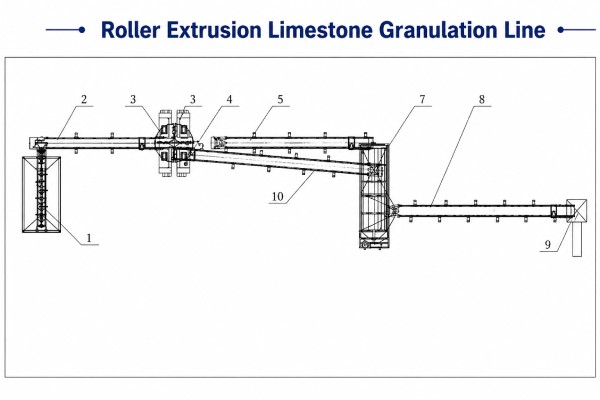
Limestone pellets manufacturing turns high-quality limestone powder into durable pellets using wet or dry granulation. Wet granulation suits large-scale fertilizer plants, producing uniform, strong pellets, while dry granulation fits small to medium-scale operations, saving energy and cost. A full wet line includes a wheel loader feeder → vertical crusher → drum screening machine → dynamic automatic batching system → rotary drum granulator → rotary dryer → rotary cooler → cyclone dust collector → drum screening machine → coating machine → single-drum packaging machine → palletizer. A dry line uses a dynamic automatic batching system → vertical mill crusher → drum screening machine → dynamic batching system → horizontal mixer → roller press granulator → screening machine → packing machine → palletizer. Proper planning ensures efficient layout, smooth production flow, and high-quality limestone pellet output.

What is the limestone pellets manufacturing process?
The process starts with preparing high-quality limestone powder, removing impurities, and ensuring uniform particle size. Adding a small amount of binder like melaza or water can improve pellet strength when using wet granulation. In granulación húmeda, you spray water or slurry onto limestone powder in a drum or disc granulator, forming uniform, pellets duraderos, ideal for large-scale fertilizer production. Dry granulation compacts limestone powder under high pressure using roller presses, followed by crushing and screening, producing consistent pellets while saving energy and reducing costs. This method suits small to medium-scale fertilizer pellet plants. Después de la granulación, screening ensures uniform pellet size, optional coating enhances flowability and reduces dust, and packaging prepares the limestone pellets for storage or shipment.
How to choose the right limestone granulation process?
Are you confused about which limestone granulation process suits your production needs? Choosing the right method depends on several key factors, including production capacity, raw material characteristics, investment and operating costs, and the quality of the final pellets.


Which equipment is included in a full limestone granulation line?
Are you curious about which equipment a complete limestone granulation process requires? A full wet granulation line includes: a wheel loader feeder → vertical crusher → drum screening machine → dynamic automatic batching machine → granulador de tambor rotatorio → rotary dryer → rotary cooler → cyclone dust collector → drum screening machine → coating machine → single-drum packaging machine → palletizer. A dry granulation line uses: dynamic automatic batching machine → vertical mill crusher → drum screening machine → dynamic batching system → horizontal mixer → roller press granulator → screening machine → packing machine → palletizer. The key equipment difference lies in focus: wet granulation lines include dryers, coolers, and coating machines to handle added moisture and binders, while dry granulation lines rely mainly on roller presses to compact and shape limestone, though they can also use coating machines to improve pellet flow and reduce dust.


Each piece of equipment ensures smooth limestone pellet production. Loaders and crushers handle raw materials efficiently, while screening machines maintain consistent particle size. Batching and mixing systems guarantee uniform formulation, and granulators form strong, durable limestone pellets. Dryers and coolers control moisture and hardness in wet lines, while dry lines achieve strength through roller pressure. Cyclone dust collectors enhance safety, and coating machines in both lines improve flowability and reduce dust. Packaging machines prepare pellets for storage or shipment. Using the right combination of machines in your fertilizer plants optimizes pellet strength, uniformity, and production efficiency while matching the correct limestone pellet machine to your process needs.
Limestone Pellets Manufacturing Line Cost: How Much Investment Do You Need?
Are you planning a limestone pellet production project and want to estimate your investment? The budget depends on the granulation process and production capacity. For a wet granulation line, a 5 t/h limestone granulation process requires approximately $190,000–$210,000, producing around 30,000 tons per year. Scaling up to 10 t/h increases the investment to $360,000–$390,000, while a 20 t/h facility needs about $550,000–$570,000 annually. For a dry granulation line, el 5 t/h capacity costs around $180,000–$190,000, 10 t/h about $350,000–$360,000, y 20 t/h approximately $520,000–$530,000.


How much space does it take to set up a limestone pellets manufacturing line?
Are you wondering how much space your limestone pellet production line will need? A 5 t/h limestone granulation process with wet granulation typically occupies around 4,500 m², while scaling up to 10 t/h increases the area to approximately 5,500 m². For a large 20 t/h wet granulation line, the space requirement expands to about 10,000 m². In contrast, a 5 t/h dry granulation line needs only around 1,500 m², 10 t/h about 3,000 m², y 20 t/h approximately 5,000 m². Knowing the floor area helps you plan a smooth production flow, select the right equipo de granulación de fertilizantes, and optimize your layout for high efficiency.


For professional limestone pellet production solutions, including wet or dry granulation lines, contact YUSHUNXIN today to optimize your fertilizer plants and ensure high-quality, efficient pellet output.


