Choose the right commercial composting equipment based on your raw material. We, YUSHUNIXN, offer groove, wheel, double-wheel, crawler, moving, and chain plate turners, plus horizontal cylinders and fermentation pots. Then pick from three commercial fertilizer composting lines that match your site and production needs, so you get a complete solution from equipment to full line.

Which type of commercial composting equipment works best for your material?
Some people pick the wrong machine for their feedstock, so they end up with poor mixing, tangled shafts, and frequent breakdowns.Our commercial composting equipment offers multiple machine types, so you choose based on your raw material.

A groove type turner works for large-scale manure or sludge. A wheel type turner suits straw and crop residue as its single wheel cuts through long fibers without wrapping. A double wheel type turner handles dense or sticky materials so nothing gets stuck. A crawler type turner works for poultry manure, distiller’s grains, or mushroom bags and it moves freely on outdoor sites. A moving type turner handles sticky chicken manure and it mixes well with sawdust. A chain plate type turner suits deep-pile materials like cow dung or sludge and its plates dig deep and turn thoroughly. A horizontal cylinder seals material for controlled indoor composting, and it works for manure or sludge. A fermentation pot suits small-batch or high-value feedstock and it gives you complete control in a compact design.
Three commercial composting lines recommended– Find the one that fits you best
Planning to set up a commercial fertilizer composting line? Not sure what equipment you need? We have three commercial fertilizer production line options ready for you.
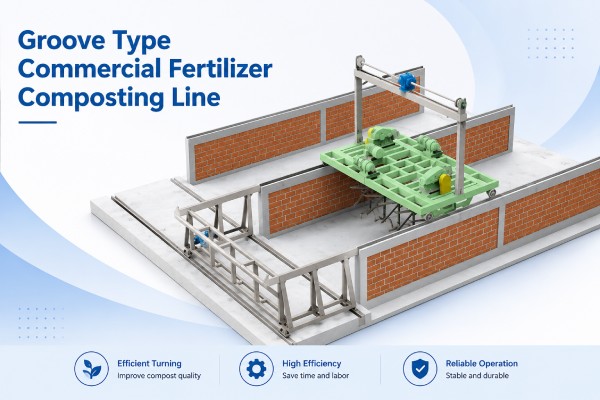
Groove-Type Fertilizer Composting Line
Choose a groove-type commercial fertilizer composting line if you run a fixed factory site, want stable daily output, have limited yard space, and need tighter odor/leachate management and more standardized operation. It’s also a good fit when you plan long-term commercial fertilizer production and want fertilizer compost quality to be consistent batch to batch.


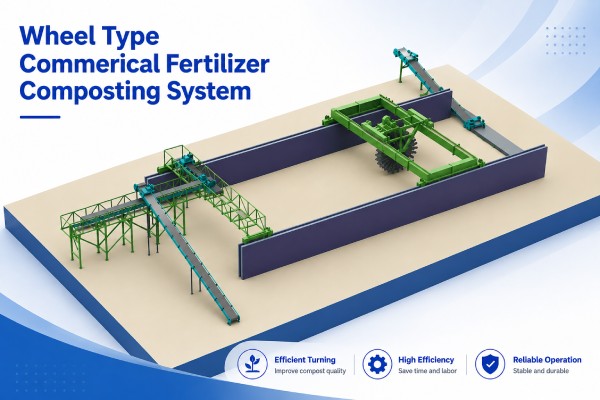
Wheel / Double-Wheel Commercial Fertilizer Composting Line
Choose a wheel or double-wheel commercial fertilizer composting line if your throughput is high, your trenches are wider/deeper, your material is heavier or more prone to clumping, and you need stronger crushing plus deeper turning to push capacity and shorten fermentation time. This option is commonly selected for scaled projects where capacity per trench is a priority.
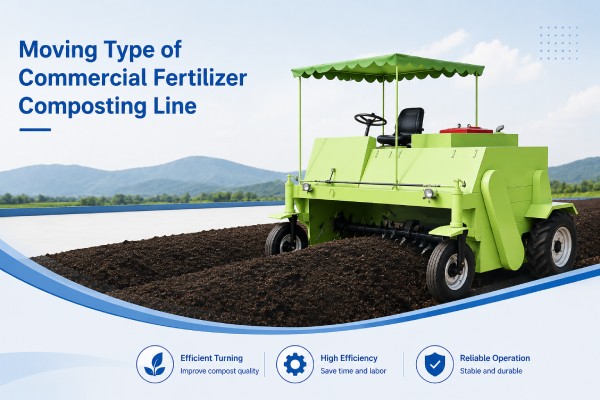
Open Windrow Fertilizer Composting Line (Crawler / Moving Type)
Choose an open windrow composting line if you mainly operate outdoors, want a flexible layout, prefer lower civil-construction investment, and may expand or adjust the yard as fertilizer production changes. It’s a practical choice for fast project launch, especially where trench construction is not convenient.
How much does a commercial fertilizer composting line cost?
Curious about the cost of these three commercial fertilizer composting lines? Let’s take a look at the follows. For small-scale operations producing 1–3 T/H, the annual output ranges from 6,000 to 18,000 T, with Line 1 (Groove-Type Fertilizer Composting Line) costing USD 19,000–26,000, Line 2 (Wheel/Double-Wheel Fertilizer Composting Line) USD 21,000–30,000, and Line 3 (Open Windrow, Crawler/Moving Type) USD 12,000–18,000. For medium-scale production of 5 T/H, the annual output reaches 30,000 T, with Line 1 at USD 25,000–34,000, Line 2 at USD 27,000–38,000, and Line 3 at USD 16,000–23,000. For large-scale production of 10 T/H, annual output is 60,000 T, with Line 1 costing USD 33,000–45,000, Line 2 USD 36,000–51,000, and Line 3 USD 21,000–30,000.