

Zeolite granulation turns zeolite powder into durable pellets through wet or dry granulation. Wet granulation uses water or slurry to make strong and uniform pellets, which suits large-scale production. Dry granulation compacts powder under high pressure, saving energy and fitting small to medium projects. A wet line usually needs feeding, crushing, screening, batching, granulation, drying, cooling, dust collection, coating, packing, and palletizing. A dry line mainly includes feeding, crushing, screening, batching, mixing, roller press granulation, screening, and packing. You can choose the right zeolite pellet production process according to capacity, budget, raw material features, and pellet quality needs.

How does zeolite granulation plan work?
Are you curious about how zeolite granulation works? The process starts with preparing the powder, removing impurities, and adding binders like lignosulfonates if needed to improve granule strength. You can choose wet granulation or dry granulation based on your production goals. Wet granulation sprays water or slurry onto the powder in a rotating drum or disc granulator. This causes particles to clump together, forming small granules, which you then dry and cool for optimal hardness. Wet granulation produces uniform, durable granules, ideal for large-scale production.

Dry granulation compacts powder under high pressure using roller presses, then crushes and screens the material into uniform granules. This method saves energy, costs less, and works well with heat-sensitive additives.And it’s ideal for small to medium-scale zeolite granulation process. After granulation, you screen granules for size consistency and optionally coat them to reduce dust, improve flowability, or enhance nutrient release. Finally, you can pack the zeolite granules for storage or shipment.
What equipment does a zeolite pellet production line need?
Are you struggling to figure out which equipment your zeolite granulation plant needs? For a wet granulation process, the line includes: a wheel loader feeder → vertical crusher → drum screening machine → dynamic automatic batching system → rotary drum granulator → rotary dryer → rotary cooler → cyclone dust collector → drum screening machine → coating machine → single-drum packaging machine → palletizer. For a dry granulation process, the line includes: wheel loader feeder → vertical crusher → drum screening machine → dynamic batching system → horizontal mixer → roller press granulator → screening machine → packing machine → palletizer.


Each piece of equipment plays a key role in the zeolite granulation plan. Loaders and crushers handle raw materials, screening machines ensure uniform particle size, and batching systems maintain consistent formulation. Granulators form strong, uniform pellets, while dryers and coolers control moisture and hardness. Dust collectors improve safety, coating machines enhance flowability, and packaging machines prepare finished products for storage or shipment.
What’s the price of a zeolite pellet production line?
Are you planning to set up a zeolite pellet production line and want to understand the required investment? For a 5 t/h zeolite plant, a wet granulation line costs approximately $210,000, producing around 30,000 tons annually, while a dry granulation line requires about $190,000 for the same output. Scaling up to 10 t/h increases the investment to $390,000 for wet granulation and $360,000 for dry granulation, delivering 60,000 tons per year. For a 15 t/h facility, wet granulation lines need roughly $570,000, while dry granulation lines require about $530,000, with an annual production of 90,000 tons.


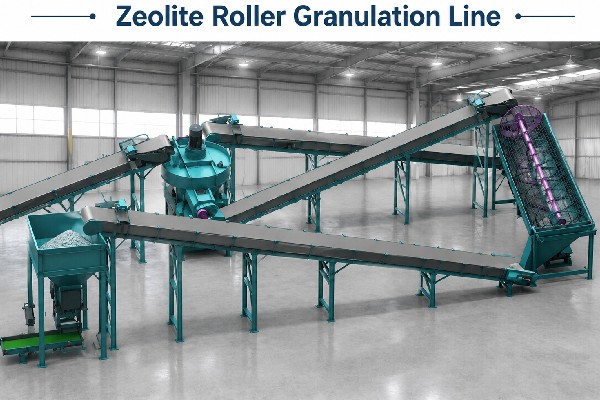
How much space does a zeolite pellet production line requires?
Are you curious about how much space a zeolite pellet production line requires? For a 5 t/h zeolite plant, a wet granulation line producing 30,000 tons per year typically occupies around 4,800 m², while a dry granulation line requires about 4,200 m². Scaling up to a 10 t/h facility with an annual output of 60,000 tons increases the area to roughly 5,800 m² for wet granulation and 5,200 m² for dry granulation. For a larger 15 t/h zeolite plant producing 90,000 tons per year, wet granulation lines expand to approximately 6,800 m², and dry granulation lines need around 6,200 m². Understanding the space requirements of your zeolite granulation plan allows you to design an efficient layout, maintain smooth production flow, and select the right equipment for your operational goals.

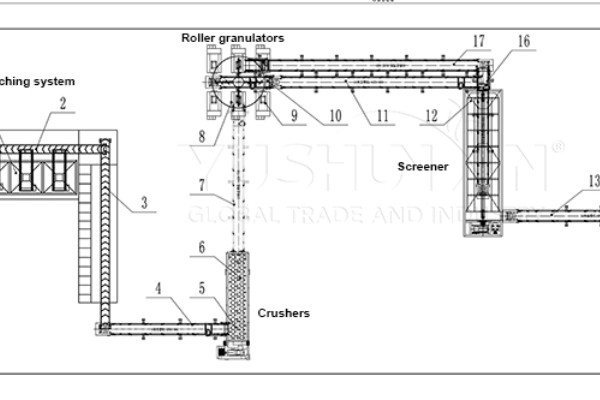

How to select a suitable zeolite granulation process for your production needs?
Are you unsure which zeolite granulation process best fits your production goals? Choosing the right method depends on several key factors: production capacity, raw material properties, investment and operating costs, and pellet quality requirements.
Production Capacity: Determine your target output per hour or per year. Wet granulation lines handle large-scale production efficiently, forming strong and uniform zeolite pellets. Dry granulation works better for small to medium-scale operations, reducing energy use and initial investment while still delivering consistent results. Raw Material Properties: Assess your zeolite powder’s particle size, moisture content, and thermal sensitivity. Wet granulation suits fine zeolite powders or situations where a small amount of binder improves pellet strength. Dry granulation avoids water and is ideal for coarse or heat-sensitive zeolite, simplifying the process and reducing drying energy.


Investment and Operating Costs: Consider equipment cost, energy consumption, and maintenance. Wet granulation requires dryers, coolers, and dust collection systems, increasing investment but producing uniform, high-strength pellets. Dry granulation reduces energy use and equipment cost while maintaining consistent pellet size through careful roller pressure adjustment. Pellet Quality Requirements: Define the strength, uniformity, and application of your zeolite pellets. Wet granulation produces durable, high-quality pellets suitable for agricultural soil improvement, industrial adsorbents, or environmental applications. Dry granulation delivers cost-effective pellets for general purposes where ultra-high uniformity is less critical.
If you need a customized zeolite pelletizing line or other fertilizer production line equipment, contact YUSHUNXIN to get expert guidance, high-quality machines, and efficient project execution from start to finish.


